
Decarbonizing India’s Commercial Buildings with Rooftop Solar & Battery Energy Storage
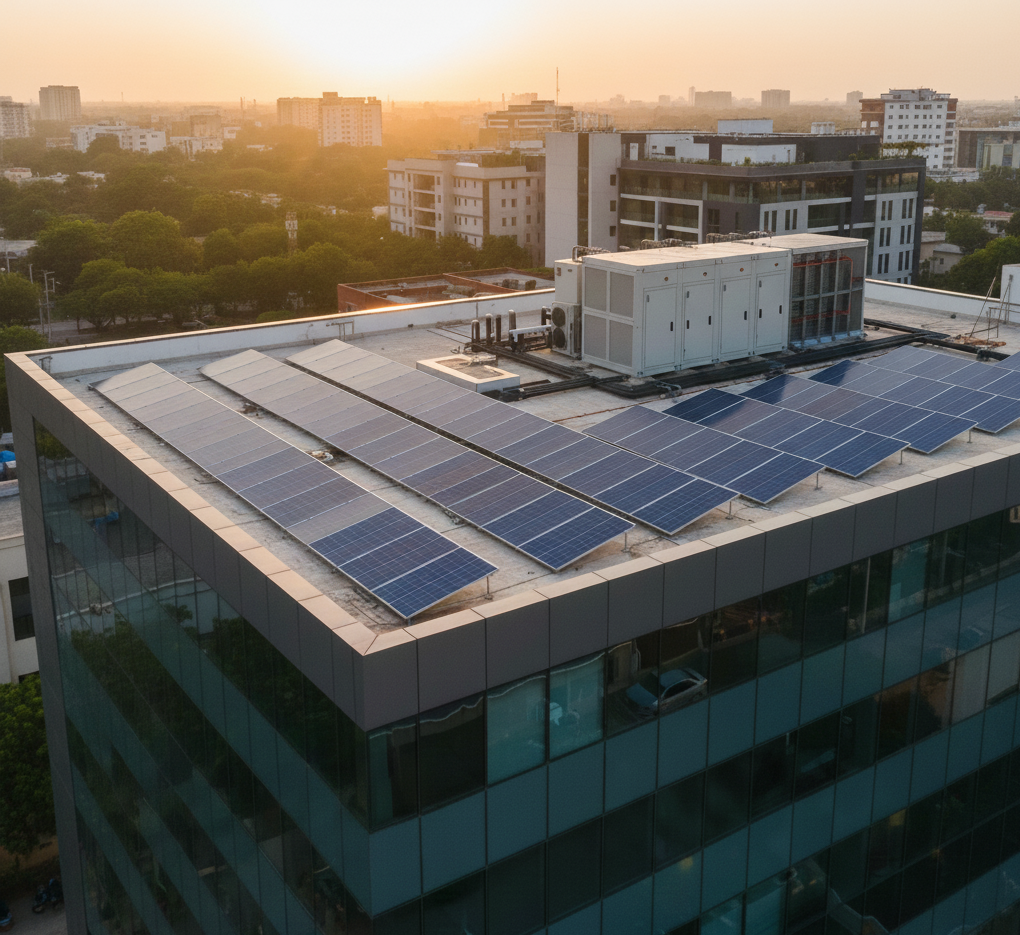
India’s commercial buildings—offices, hotels, large campuses—are major energy consumers. As businesses look to cut energy costs, reduce emissions, and meet sustainability commitments, rooftop solar combined with battery energy storage is emerging as a practical and forward-looking solution. These systems help lower reliance on the grid, keep essential operations running during power cuts, and support clean energy use.
Why Commercial Buildings Should Adopt Solar & Battery Energy Storage
Commercial loads typically peak during daytime working hours and can extend into evening periods. Rooftop solar can meet a substantial part of daytime demand, reducing the amount of electricity drawn from the grid. Battery energy storage strengthens this benefit by storing excess solar power generated during the day for use later, especially when tariffs are higher or when grid supply is unreliable. In India, the Energy Conservation Building Code (ECBC) sets efficiency requirements for new commercial buildings and encourages the use of on-site renewables to lower electricity demand from the grid. Similarly, the Green Rating for Integrated Habitat Assessment (GRIHA) and the Indian Green Building Council (IGBC) rating systems include credits for rooftop solar and other renewable measures, supporting commercial buildings working toward higher sustainability performance and, where applicable, net-zero operational energy goals.Business Case: Savings & Sustainability
- Cost Savings & Predictability Investing in rooftop solar lowers a building’s exposure to rising electricity tariffs. Adding battery storage allows buildings to use stored solar power instead of paying higher tariffs during non-solar peak hours. Over time, the return-on-investment can be strong, especially when financed smartly.
- ESG & Green Building Certification Many corporates are already championing sustainability: programs like CII GreenPro and IGBC (Indian Green Building Council) promote solar plus battery energy storage as a way to reduce operational emissions and earn green building points. Installing rooftop solar systems can thus directly contribute to green building credentials, helping companies meet both ESG and regulatory targets.
- Energy Resilience Battery-backed solar systems enhance energy security: during grid outages or peak load stress, these installations can supply critical loads. Solar systems with batteries can keep important services running like data centres, lifts, security and emergency equipment. For commercial buildings, this translates into fewer disruptions, better business continuity, and a more reliable power supply.
- Global Compliance & Future-proofing As global trade evolves, regulations like the EU’s Carbon Border Adjustment Mechanism (CBAM) are pushing companies to decarbonize their supply chains. Corporates that operate or source from Europe may benefit from on-site solar plus battery energy storage in Indian facilities, reducing their indirect carbon footprint and aligning their operations with CBAM compliance strategies.
Real-World Examples & Evidence
- India’s Commercial and Industrial (C&I) rooftop solar segment remains one of the largest and fastest-growing distributed solar power markets in the country, driven by attractive paybacks and corporate decarbonization commitments.
- Building-specific studies show measurable improvements in energy autonomy and peak-load reduction when PV and storage are co-sized to local demand patterns.
- Studies show that battery prices have fallen, improving the affordability of solar-plus-storage solutions.
How to Implement: A Step-by-Step Guide
- Site Assessment & Sizing Assess your rooftop area, shade profile, and load curve. Use tools like Solsavi’s rooftop solar calculator guide to estimate capacity, expected generation, and payback.
- Choose Your Financial Model Decide between owning the system (CAPEX) or working with a third-party developer (OPEX) to reduce upfront costs. Evaluate financing options and expected returns in light of your energy needs.
- Regulatory Alignment Check your state’s net-metering or net-billing policies, and align your system with applicable rooftop solar policies in India. Make sure your plans also consider any energy export to the grid if permitted.
- Select the Right Technology For inverters, battery energy storage, and panels, factor in system size, reliability, and warranty. Consider AC- vs DC-coupled battery systems, as highlighted in Solsavi’s blog, comparing those architectures.
- Monitoring & Maintenance Adopt IoT-enabled monitoring (refer to IoT rooftop solar benefits) to track and optimize production, ensure system health, and maximize savings. Regular checks and performance evaluation are critical to long-term ROI.