
How Apartment Societies Can Slash Common Electricity Costs with Solar
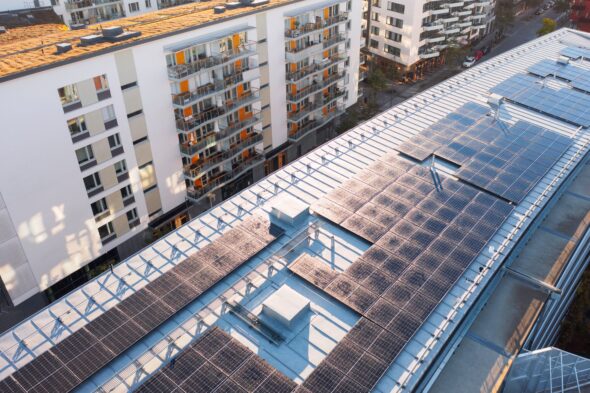
If you live in an apartment complex, you’ve likely noticed that a sizable portion of your monthly maintenance fee goes toward electricity. Corridor lighting, elevators, water pumps, security systems, clubhouses, parking lights — these shared facilities often run almost round the clock.
In many Indian cities, common-area meters are billed at commercial or higher domestic tariffs. As electricity rates rise, these shared costs steadily increase — and residents absorb them collectively. Rooftop solar offers apartment communities a practical way to generate clean power for common loads, reduce maintenance expenses, and protect themselves from future tariff hikes. In this blog, we explore how residential societies in India can adopt rooftop solar for common areas. We’ll cover:
- The operational models available (ownership and financing options)
- Legal and regulatory considerations
- Government incentives that improve financial viability
- Real-life success stories
- Benefits of Rooftop Solar for shared amenities
Switching common-area electricity to rooftop solar isn’t just about sustainability — it makes financial and operational sense.
Cost Savings
A properly sized solar PV system can offset a significant portion of common electricity consumption. Societies can align high-energy daytime loads — such as water pumping — with solar generation hours. The outcome is straightforward: lower electricity bills for shared facilities, which translates into reduced monthly maintenance charges for residents.
Protection Against Tariff Hikes
Solar panels generate electricity for 25 years or more. After installation, the primary ongoing expense is maintenance. As grid electricity tariffs rise, the savings from solar increase. In effect, the higher the tariff climbs, the more valuable your rooftop system becomes.
Legal Compliance
Rooftop solar also helps societies align with evolving building and sustainability regulations. For example, solar installations can support compliance with:
- Energy Conservation Building Code (ECBC) provisions for residential buildings
- National Building Code (NBC) safety requirements
Solar reduces dependence on the grid during daylight hours. While it does not provide 24×7 electricity on its own, societies can enhance reliability further by integrating battery storage systems.
Financing Models
CAPEX (Society-Owned) Model
Under the CAPEX model, the Resident Welfare Association (RWA) or housing society invests directly in the solar plant.
Key Features:
- Funds may come from society reserves or a one-time contribution from residents.
- The RWA owns the solar asset.
- Electricity generated powers common facilities.
- If upfront funds are limited, societies can take loans. Many banks now offer solar financing at reasonable interest rates. In many cases, the EMI can be structured so that it is largely offset by monthly electricity savings — minimizing additional financial burden.
Once the loan is repaid, the society retains full ownership and enjoys the complete benefit of savings for the remaining life of the system.
OPEX / RESCO (Third-Party Owned) Model
In this model, the society avoids upfront investment. A Renewable Energy Service Company (RESCO) installs and owns the solar plant. The society signs a l Power Purchase Agreement (PPA), typically 10–25 years, to purchase solar electricity at an agreed tariff per unit of solar.
Key features:
- No capital investment by the society
- Solar tariff is lower than the prevailing grid tariff
- Immediate savings from day one
- Maintenance handled by the developer
After the PPA period ends, ownership may transfer to the society, or terms may be renegotiated. This model works well for societies that prefer operational savings without capital commitment.
Legal and Regulatory Considerations
Solar installations must comply with Central Electricity Authority (CEA) regulations, Bureau of Indian Standards (BIS) norms, and DISCOM interconnection requirements.
Rooftop Ownership and Permissions: The RWA or cooperative housing society must have formal rights to use the rooftop. This typically requires approval through a general body resolution.
Technical Standards and Safety: Solar installations must comply with Central Electricity Authority (CEA) standards and DISCOM requirements. This includes:
- Use of inverters compliant with applicable BIS/CEA/BEE standards
- Proper wiring and protection systems
- DC/AC isolators
- Earthing systems
- Lightning arrester installation
Since panels are installed on rooftops, lightning protection is essential for safety and system longevity.
Regulatory Approval and Metering: All grid-connected systems require approval from the local electricity utility. Depending on state regulations, societies may opt for:
- Net metering
- Net billing
- Gross metering
For a detailed explanation of each solar metering mechanisms read this blog: Understanding Rooftop Solar Policies Across India
State-specific regulations matter. For example: Regulations inDelhi allow net metering for residential projects up to 500 kW, while in Maharashtra, regulations permit net metering up to the contract demand limit. Understanding these frameworks ensures the system is designed to maximize financial returns.
Group Net Metering and Virtual Net Metering
Several states have introduced flexible frameworks to make better use of rooftop space, with net-metering providing the best returns when available.
- Group Net Metering (GNM) allows surplus power from one common meter to be credited to other meters owned by the same entity — useful for large societies with multiple service connections.
- Virtual Net Metering (VNM) goes further. Multiple consumers can collectively own a solar plant and share generation credits in predefined ratios, even across different meters.
Government Incentives and Policies
India’s residential rooftop solar push is backed by a national subsidy scheme and complementary state-level regulations.
Pradhan Mantri Surya Ghar Muft Bijli Yojana
Launched in February 2024, the PM SuryaGhar program aims to install rooftop solar in 10 million (1 crore) households by FY2027, targeting 30 GW of residential capacity.The scheme provides direct Central Financial Assistance (CFA) or subsidies:
For individual homes:
- First 2 kW of rooftop solar capacity or part thereof will receive 60% CFA of the benchmark cost of 2 kW, which can be ₹30,000 per kW for the first 2 kW
- With additional rooftop solar capacity of 1 kW or part thereof, will receive 40% CFA of the benchmark cost of additional kW, which can be ₹18,000 per kW for the next 1 kW
- Maximum subsidy: ₹78,000 (up to 3 kW system)
- Panels must meet the Domestic Content Requirement (DCR, made in India) to qualify.
For Group Housing Societies (GHS) / RWAs:
- ₹18,000 per kW for solar plants serving common facilities
- Eligible capacity up to 500 kW
- Cap calculated at 3 kW per house
- Panels must meet DCR to qualify.
For example, a 100-flat society can claim subsidy for up to 300 kW (100 × 3 kW), subject to the 500 kW maximum. An apartment owner can benefit from both achieving a maximum of 1.3L subsidy if the individual installation exceeds 3kW, and the common share exceeds 3kW, at the same time.
Municipal Incentives
Some cities provide additional tax incentives:
- Pune Municipal Corporation offers a 5% property tax rebate for operational solar systems.
- Lucknow Municipal Corporation provides a 10% exemption for residences and water taxes.
- In cities like Mumbai and Indore, smaller rebates (around 2%) have been proposed, though policies are not uniformly implemented.
Residents should confirm current rules with their municipal authorities.
Success Stories of Apartment Societies Going Solar
Early adopters show what is possible.
Pune – 200 Apartments
- A 200-apartment society installed 45 kW of solar between 2017 and 2019.
- Monthly common-area bills: ~₹3.5 lakh
- Total investment: ~₹31 lakh
- By aligning daytime loads with solar generation, they reduced grid consumption and moved to lower tariff slabs — cutting thousands from monthly bills.
Bengaluru – 342 kW System
A residential complex installed a 342 kW system in December 2023.
- Annual generation: ~0.55 million units
- Pre-solar annual electricity cost: ~₹12 million
- Annual savings: ₹4–4.5 million (about 33% reduction)
- System cost: ₹2.4 crore
- Estimated break-even: ~4.75 years
- The project was funded collectively by the apartment owners’ association.
Conclusion
For apartment societies, rooftop solar is no longer experimental — it is increasingly practical and financially sound. It converts unused roof space into a long-term asset. It lowers common area expenses. It cushions against tariff hikes. And it contributes to cleaner urban energy. For societies willing to collaborate and plan carefully, rooftop solar turns sunlight into measurable savings — year after year.